
As seen on What’s Up Downunder
Kayaking the Noosa Everglades From the Southern End
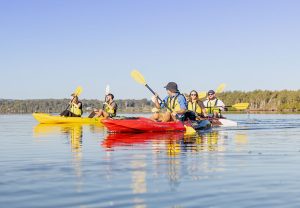
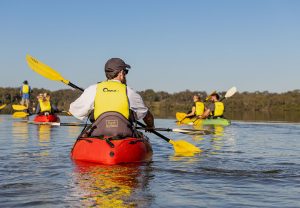
When the What’s Up Downunder crew came to film the southern section of the Noosa Everglades, they came out on the water with us.
Our guide Matt Smith, a former Queensland Parks and Wildlife ranger, took presenter, Felicity Palmateer across Lake Weyba and into its branching, mangrove lined waterways.
The episode shows the southern end of the Noosa Everglades the way we see it most days: clear shallow water, stingrays under the kayak, narrow creeks and mirrored waterways where the mangroves close in overhead.
If you are looking for a Noosa kayak tour that is close to town, suits beginners and shows you a side of the everglades that most visitors never see, this is it.
Here is what makes the southern end worth paddling, and what you can expect on our Stingrays & Everglades Kayak Tour.
As Seen on What’s Up Downunder
What’s Up Downunder is an Australian travel show that heads out to experience the country’s outdoor adventures first hand. For this episode Felicity joined Matt for a paddle on Lake Weyba, and he started with the name itself:
“Welcome to Weyba, which actually means in the local Indigenous language, Kabi Kabi, place of stingrays. So this place has been a stingray sanctuary forever.”
From there the pair paddled out across the lake, found juvenile stingrays in the shallows, and slipped into Eenie Creek and Keyser Creek to explore the mangroves. Watch the full episode further down this page.

The whole system
The Noosa Everglades: One Connected System
How Big Is the Noosa Everglades?
The Noosa Everglades is often described as one of only two everglades in the world, the other being the Florida Everglades. What makes it an everglades is not a single lake or river. It is the way the whole catchment works together: slow moving water, shallow lakes, floodplains and a smooth transition from fresh water to the sea.
The system runs for about 65 km, from the coastal wetlands through the lower lakes to the upper Noosa River. It covers a catchment of around 85,000 hectares, with more than 50 ecosystems and more than 700 native species (figures from The Noosa Everglades).
One System, Many Parts
The Noosa Everglades takes in the Upper Noosa River (the River of Mirrors), Lake Cootharaba, Lake Cooroibah, Lake Como, Lake Doonella, Lake Cooloola, Lake Weyba, Harry’s Hut, Laguna Bay and the lower Noosa estuary.
Most people picture the northern reaches around Boreen Point and Harry’s Hut. Fewer realise that Lake Weyba, a few minutes from Noosaville, is the southern end of the same system and as much a part of the everglades as any other stretch of that water. You can read more about how it all connects in our guide to understanding the Noosa Everglades system.
Why the southern end
Why Kayak the Southern End of the Noosa Everglades
Lake Weyba, the Southern Gateway
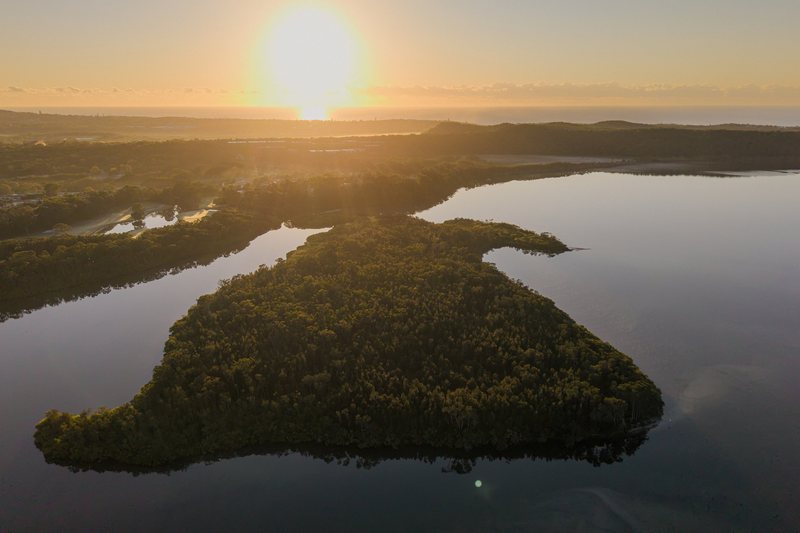
Lake Weyba is often called the southern gateway of the Noosa Everglades. It is a broad, shallow coastal lake where tannin rich fresh water meets the influence of the sea, fringed by mangroves and paperbark wetlands.
As Matt puts it in the episode, “We’re at pretty much the most southern point of the Noosa Everglades system.” Paddle up Weyba Creek and you join the Noosa River. Turn right and you head for the Pacific Ocean. Turn left and you head further up the everglades.
Close to Noosa and Easy to Reach
Our kayak tours launch from the end of Lake Weyba Drive in Noosaville, a few minutes from Hastings Street, with free parking at the launch. There is no long drive north to Boreen Point before you get on the water, and the paddle across the lake to the creeks is a pleasant and achievable one.
The guided tour is rated easy and while a general level of fitness is required, as would be for any physical activity, no extensive kayaking experience is needed, so it works for families and experienced paddlers alike. Children 12 and under paddle in a double kayak with an adult.
Place of stingrays
Lake Weyba: The Place of Stingrays
Weyba means place of stingrays in the local Kabi Kabi language, and the name still fits. Stingrays come into the lake’s shallows to “breed, give birth, grow up, and then head out into that deeper water”, as Matt explains in the episode. The shallow water gives the young rays a safe place to grow before they head out into deeper water.
Which Stingrays Will You See?
The most common is the cowtail ray. The ones seen during filming were juveniles, but cowtail rays can grow to around 1.8 m across. You may also see the estuary stingray, a brown ray found only on Australia’s east coast, from central Queensland down to New South Wales.
Look up as well as down. Pelicans, ospreys, white-bellied sea eagles and migratory shorebirds all use the lake.
An Honest Word on Wildlife
Stingrays are commonly seen on this tour, especially in calm conditions, but they are wild animals and sightings can’t be guaranteed. Matt says it best: “I can never promise stingrays because they are wild animals.” Still, clear water over a sandy bottom gives you a very good chance of watching one glide under your kayak.
Mangroves
Kayak Through the Mangroves
This is what really sets the southern end apart. Around Lake Weyba the water is estuarine, a mix of fresh and salt, and that is where mangroves grow. Further up the system the water turns fresh and the mangroves drop away.
In Matt’s words, “What makes this really special down this end is the mangroves. They’ll actually disappear once it starts to go into the freshwater.” If you want to kayak through mangrove forest in the Noosa Everglades, the southern end is where you will find it.
Why Mangroves Matter
Mangroves do a lot of quiet work. Their roots hold the banks together and filter pollutants out of the water.
They are also nurseries. Queensland Parks and Wildlife says more than 70% of commercially and recreationally caught fish and prawns depend on mangrove habitat at some stage of their life, for shelter, food and a safe place to grow (source).
And they are one of the most concentrated carbon stores on the planet. Per hectare, mangroves hold three to five times more carbon than tropical rainforests, most of it locked away in the mud beneath them, and they draw new carbon out of the air about ten times faster than a mature rainforest (NOAA).
The creeks
Paddling Eenie Creek and Keyser Creek
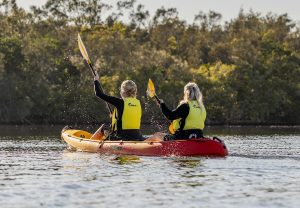
Across the lake from the launch, Eenie Creek and Keyser Creek wind back into the mangroves and paperbark wetlands. The creeks are narrow and sheltered, and on a still day the tannin coloured water turns to a mirror that doubles every branch above you.
The pace slows right down in here. You paddle under overhanging branches, past mangrove roots at the waterline, with the open lake out of sight behind you. It is the most peaceful part of the trip and the part that feels furthest from town, even though you are only a few minutes from Noosaville.
Watch the episode
Watch the What’s Up Downunder Episode
Keep Exploring
Learn how the whole system fits together in Understanding the Noosa Everglades System, see how we look after it on our Sustainability page, or read why we think conservation begins with connection.
Photography by Matt Sample, Platinum Vision. Episode footage and stills courtesy of What’s Up Downunder.
Common questions
Noosa Everglades Kayak Tour FAQs
Yes. Lake Weyba is the southern end of the Noosa Everglades, and our kayak tours launch from the end of Lake Weyba Drive in Noosaville, a few minutes from Hastings Street. There is free parking at the launch.
Stingrays are commonly seen on the tour, especially in calm conditions. They are wild animals, so sightings can’t be guaranteed.
No. The guided tour is rated easy and suits beginners. The self guided tour is best for confident paddlers who are comfortable finding their own way with the map and directions we provide.
Yes, with an adult. Children 12 and under paddle in a double kayak with an adult, and children 3 and under come free.
Three hours for the guided, self guided and private guided tours. Current prices and departure times are on each tour page.
They are one connected system. The northern reaches, around Lake Cootharaba, Harry’s Hut and the Upper Noosa River, are freshwater and known for their dark, mirror-like water. The southern end, Lake Weyba and its creeks, is estuarine, which is why it has mangroves and stingrays. It is also much closer to Noosa’s main towns.
Book your paddle
Ready to Kayak the Southern Noosa Everglades?
Choose the guided tour and paddle with one of our local guides, head out at your own pace on the self guided tour with a map, directions and a safety briefing, or book a private guided tour for your own group. Every option runs for three hours and includes all kayaking and safety equipment. Check each tour page for current prices and departure times.